Showing posts with label meat. Show all posts

Thursday, November 28, 2013

Steak Tartare

I admit Steak Tartare may not be something you associate with winter food.
It's cold, it's fresh and would fit much better into a light summer dish.

However, after lots of braised meat, we felt like having something lighter for dinner.

When younger I used to be absolutely disgusted by the idea of eating raw meat.
Sushi kind of paved the way at the turn of the millennium for me to be more open-minded and willing to experiment with raw fish and meat.
But it certainly took me a while and an incredibly good Steak Tartare hors d'oeuvre I was served in a restaurant once, to get used to the idea.

Most important with dishes like this is definitely the freshness of the ingredients.
Therefore get your meat from a butcher you trust and fresh (organic) eggs.


Here is what you need for two servings (large portions) or 4 servings (appetizer size):

400g of beef tenderloin/filet
2 shallots finely chopped
2 tsp parsley, finely chopped
2 tsp chive, finely chopped
1 tsp of capers, finely chopped
2 small pickles/cornichons finely chopped
1 tsp (hot) mustard
6 splashes of Tabasco
1 tsp Worcestershire sauce
salt
pepper

Also:
two egg yolks (4 small egg yolks, if it is for 4 servings)
good balsamic vinegar or crema di balsamico


Directions:

Remove fat and connective tissue from the meat if necessary.
Chop the meat very finely with a sharp knife (NOT in the meat grinder)
Mix together with all the other ingredients.
Form 2-4 patties and create a little crater on the top surface of each of them.
Carefully place an egg yolk in each crater.

Sprinkle with balsamic vinegar or crema di balsamcio.

Serve immediately with salad and (toasted) bread.

Notes:
All the measurements for the ingredients are approximately. Feel free to adjust and season to taste.
I used more mustard, worcestershire sauce and capers then asked in the recipe for example.

Oh yeah, and the birds are happy about their never ending winter food supply as well!


Tuesday, December 11, 2012

Trotter Gear, by Fergus Henderson

If you like pies and stews, and if you like adding that little bit of extra flavor to your hearty winter meals, then you should always have a jar of trotter gear in your fridge.

What exactly is Trotter Gear?
Trotter Gear is a rich gelatinous stock made out of pork trotters.

By adding Trotter Gear to stews, sauces or soups they become richer, creamier and more flavorful.

pig's trotters - they are in fact good for something.


I know, some of you may be grossed out by this, but I share Fergus Henderson's opinion of using all the parts of an animal, rather than just picking favorites or the best looking ones. 
A piece of steak to most people does not appear to be disgusting, at all. But pig's ears, bone marrow or beef tongue are? In the end you are eating parts of an animal, whether it is a filet mignon, trotters or gummi bears.

Don't get me wrong. I would never force someone to eat something they don't feel comfortable with.
In fact, I would have a hard time eating eyes for example. Actually, I don't think I could at all...

But I do think that by being aware where your steak and BBQ-ribs come from (a whole animal with eyes, a heart, organs and, yes, feelings) it allows you to respect and appreciate (animal) life and therefore your daily piece of meat much more.


So, here is what you need for Fergus Henderson's recipe of his so-called "Healthy Jar Of Trotter Gear":

pigs' trotters (all hair removed) 6
onions 2, peeled
carrots 2, peeled
celery 2 sticks
leeks 2, split
garlic 1 head
thyme a bundle
peppercorns a handful
Sercial Madeira ½ bottle (Sherry works fine, as well)
chicken stock enough to cover the trotters


Directions:

Shave the trotters! You want to get rid of all the stiff hairs...


Place the trotters in a large casserole. Cover with water and bring to the boil. Boil for 5 minutes then drain. This removes the initial scum given off by the trotters. 

Now place the blanched trotters in the pot with the vegetables, thyme, peppercorns and Madeira and cover with the stock. Cook for at least 3 hours until the trotters are totally giving. At this point, strain the cooking liquid and keep. 

After 3 hours the pig's trotter has mutated into an alien and is ready to get pulled apart...

When the trotters are cool enough to handle (but don't let them go cold, as they become much harder to deal with), pick all the flesh, fat and skin off them tearing the skin to shreds. 

I love pulling all the flesh, skin and fat off the bone

Add to the cooking liquid, seal in a jar and refrigerate. 


You now have trotter gear – giving, wobbly trotter captured in a splendid jelly.

For more information on Fergus Henderson and how to eat the whole beast check out his books
'Nose To Tail Eating: A Kind Of British Cooking' and 'Beyond Nose To Tail', as well as his restaurant St. John in London.


Monday, May 7, 2012

Standing Rib Roast

Hey everyone,

Last saturday Wil and I celebrated our anniversary...or better anniversaries! Three years ago Wil stepped into the bar where I used to work at this point. That's how we met... And last year around the same time Wil proposed to me in the most beautiful vineyard in France.

Le feast


We still had a bottle of wine of this particular vineyard, a 2007 "Chateau la Nerthe" from Chateau-Neuf Du Pape, as well as a bottle of the vineyard we went after the proposal "Domaine Le Pointu", a family business run in its third generation with really good wine and the nicest and most generous people.


Les wines

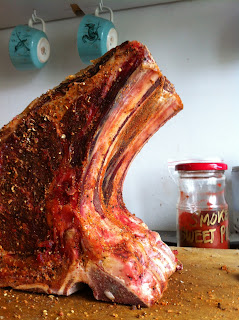
We decided that this would be the perfect day to empty these two very special bottles, and what better than to pair them with a giant standing Rib Roast/Cote Du Boeuf, seared on the barbecue and finished in the oven until medium rare?

Le meat

We went to our favorite market place butcher here in Berlin, Prenzlauer Berg, and asked him to dry-age around 2 kilos of rib eye for 4 weeks.
When we picked it up a couple of weeks later it turned out to  be "slightly" more than 2 kilos and we went home with a dinosauresque monster piece of 2.7 kg/ 6 lbs of beautifully aged meat for 32.50€ (!!!).

Here is the proof: it was HUGE!

Back home we unpacked the rib-roast and let it reach room temperature. We seasoned it with a spice rub of olive oil, smoked paprika powder, shanghai pepper, thyme and salt.
Smoked sweet paprika: my new favorite spice for all kinds of dishes and any kind of meat!


Before firing up the barbecue (with charcoal for more heat!)
we opened the wine bottles to allow the wine to breathe.
Once the barbecue was hot enough, we seared the rib-eye for 3-4 minutes each side.

We tied the roast with some strings to prevent it from bending while searing.
After that we placed the roast in a deep pan, bones facing down with the whole roast standing up, so that the heat could get everywhere evenly.  We surrounded it by some rosemary twigs, garlic cloves and butter cubes and cooked it for another 1 hour and 15 minutes at around 130°-150°C.

Wurst Cook Ever with our (now) standing rib roast!


Unfortunately that's the lowest our gas oven gets. If you can cook it at a lower temperature, go ahead. 
It'll take longer, probably two to three hours, depending on the temperature of course. 
But it will be even more tender.
A meat thermometer definitely is a good investment here.

meat thermometer...

For medium-rare the temperature in the center needs to be at 55-60°C. Therefore once the meat reaches 50-52° (rare), pull it out, wrap it in aluminium foil and let it rest for around 10 minutes. While resting more heat will get inside the beef which in the end will heat it up a few more degrees to turn it medium-rare.

Most of the weight comes from the giant bone...
Just like the fat, the bone adds some really nice flavors, especially when barbecued.

Look at how juicy, tender and pink it is! Nom nom...
The white stuff is connective tissue. 
Unfortunately Rib-roasts have a fair bit of that chewy stuff. Just cut it out. 
You don't want to eat that...


By adding a bit of wine to the drippings and reducing them over heat we made a nicely rich sauce to serve together with the sliced meat.

the meat served with some caprese salad

The roast had a nice beefy flavor and tasted delicious. It was really tender and juicy and the two wines (grenache, syrah) were a perfect fit, as well!

Dry-aging for four weeks instead of two or three definitely makes a difference. The longer the meat ages the more water it loses and the more the flavors can concentrate.
Some even swear by dry aging beef for six weeks to get the maximum flavor out of it.

We drank all the wine, but still have plenty of leftover roast for sandwiches...

Notes:

1. I don't fully agree with the common idea to not salt the meat before cooking. I think it really depends on the kind of meat. Thin steaks and lean filets, ok, don't salt them, or at least not that much. 
But if it is a thick piece and/or the meat has some fat, don't worry about that. 
The fat will prevent it from drying out.

2. I also prefer to rub the meat with spices and herbs before searing. That way the spices have the chance to soak a little bit into the meat. I also really really like the slightly burnt flavor, that this creates...

Sunday, April 29, 2012

Crusty Pork Roast

Except for bacon, ham or salami, I'm not the biggest pork eater. I find pork is often gets too dry and yes, it has this particular pork-flavor that, depending on its preparation tends to give me a hard time. 

We most of the time go for beef. So I decided it's time to try something different and give it a try with a pretty Bavarian style crusty pork roast. I took the idea and the original recipe from the current issue of the German magazine BEEF! and altered it a little bit. They got a pork special right now and all the recipes in there sounded pretty delicious.

For my first crusty pork roast it turned out pretty well. Not dry at all and with nice flavors (beer, caraway and maple syrup). And we have so many leftovers... Pork sandwiches it is!


Here is what you need for 6 people or tons of leftovers:

2.5kg pork roast from the shoulder (we got thigh/ham, that's fine as well)
1l beer (Lager, Pilsner)
1 tsp caraway
2 garlic cloves roughly chopped
2 onions roughly chopped
3 bay leaves
3 juniper berries
maple syrup (approx. 3-4Tbsp)
salt, pepper


Directions:

Preheat oven to 175°C

1. Pour water in a wide pot or pan to about 3cm height. Bring to boil.

2. place the pork roast, skin side facing the bottom, in the pot and brew it for about 15 minutes.


Be careful not to accidentally burn the skin while brewing already, like I did...

3. Now with a sharp knife cut the skin horizontally and vertically to create little skin cubes...

4. Put the roast with the skin side up in a deep baking tray or oven proof pan or pot and place the onions and garlic around the roast.

5. Bake for 2.5 hours.

6. After 15 minutes in the oven add about 1l of the water used for brewing the meat and add caraway, bay leaves, juniper berries, salt and pepper.

7. About 60 minutes later, crack the first beer (0.5 l) and pour over the roast.

8. 30 minutes before end pour the other 0.5 liters of beer over the roast.

9. 10 minutes before end brush the skin of the roast with maple syrup and turn the heat up to max. (be careful not to burn the roast!)

10. Remove roast from the oven and let it rest for 5-10 minutes.

11. In the meantime take some of the beer-onion liquid, blend it until smooth and reduce over heat to a nice sauce. Season to taste with salt, pepper and maple syrup if necessary.

Oh yeah, and pair with a bottle of good ice cold beer.
Serve the roast cut in slices with potatoes or green beans and sauce.


Notes: We served it with white asparagus. That was not the best fit. The asparagus tastes weird with the beer sauce. Better go with something more neutral like potatoes...


PS: I really miss my camera. Those cell phone photos are something else...

Thursday, December 8, 2011

Why Onglet and Bavette is the new Filet

I love a good medium-rare Filet Mignon. It's tender and when prepared correctly almost melts in your mouth. The only problem with filet, compared to other parts of a cow, is that it is not as flavorful. It doesn't have much fat and comes without a bone, which both usually add quite a bit of flavour to the meat. It's also kind of "lazy" meat and doesn't get used much by a cow, means, it sits nicely protected in a body part where there is not much muscle activity, which as well, would make more flavourful meat.

There are however parts that get used a lot and are quite active. That's where butchers cut steaks such as Bavette or Onglet. Bavette, which is also called Flank-steak is cut from the abdominal muscles of the cow. Onglet, or Hanger-steak, is V-shaped and obtained from the diaphragm of the heifer or the steer. Both are significantly tougher than other meats. Therefore it's best prepared when marinated and quickly seared on both sides for about 3 minutes in a hot cast-iron pan. When served you're better to cut it into thin slices. With thin and tough cuts like this, you should only salt the meat after searing it.

original image found on wikipedia

Especially Onglet used to be what butchers would rather keep for themselves. Everyone likes their meat to be as tender as possible, so there has not been much interest in those kinds of cuts, until now.
But a butcher's preference can't be that bad, right? And really, it's not that tough if you prepare it right. Just make sure it stays medium rare or absolute maximum medium. Then everything should be fine.

In a very hot (cast iron) pan sear the steaks on both sides for 2.5-3 minutes
Onglet is so strong in flavour that it almost tastes organy, like liver or heart. For some people maybe a bit too intense. Bavette is a little milder, so that might be a better to start off with. But really Onglet is pretty damn good. You should try it.

After searing, wrap the steaks in aluminium foil and let it sit for at least 6 minutes.
Here in Germany Onglet and Bavette are so unpopular, or let's better say unknown, that they get sold (if they get sold) surprisingly cheap. We bought both at Galerie Lafayette, that fancy department store on Friedrichstraße. They were well-aged and each costed around 10€ for about 500g. That's nothing over here, where 100g of filet usually ranges between 4 and 8€.

it's perfect when it's medium rare!
PS: we ate ours unmarinated. Just had it reach room temperature, rubbed it in crushed pepper corns and a tiny bit of olive oil and seared it from both sides for 2.5 - 3 minutes in an extremely hot cast iron pan. Than wrapped the steaks in aluminum foil and had them rest for at least 6 minutes.

Sunday, October 9, 2011

The Vegan Experiment Day 8 - the finals

Ok, a little late, but here it is: day 8, the last day of my temporary veganism.
Since it is fall and there are pumkins everywhere I decided to try out two vegan pumkin recipes that I found on www.vegalicious.com.


I started the day with a pumkin banana orange smoothie for which I mixed 

1 cup (240ml) vanilla soy yogurt
1 cup (240ml) pumpkin puree, chilled
1 cup (240ml) orange juice
1 tablespoon brown sugar
1/2 teaspoon ground cinnamon
1/2 teaspoon allspice
1 ripe banana
dash of ground cinnamon as optional garnish    


You don't have to be too correct about the measurements. Just vary the ingredients however you prefer it! I think with real yoghurt it may taste a bit better. The soy yoghurt just doesn't do it for me.
But besides that, the smoothie was alright. Maybe a bit more allspice and cinnamon to bring out the pumkin flavour. 

For dinner I took the leftover pumkin purree from this morning's breakfast smoothie and made pasta with a nice pumkin pistacchio pasta sauce.


That's what you need for about two servings:


  • 1/2 onion, chopped fine
  • 1/2 red bell pepper, chopped fine
  • 1 tablespoon oil
  • 2 cloves garlic, minced
  • 1 cup pumpkin puree
  • 1 vegetable bouillon cube
  • 1 teaspoon ground nutmeg
  • dash of red pepper flakes
  • 1/2 cup water
  • 3-5 fresh sage leaves (optional)
  • 1/2 lb. penne, fusilli or other pasta
  • 3 TBS. minced fresh parsley leaves as optional garish
  • 1/3 cup finely chopped pistachios
Directions:
                                              Saute the onion and red pepper in a small frying pan.
    When the onion becomes soft and glassy, add the garlic and lightly saute it also.
    Place the pureed pumpkin in a pot and add the sauteed vegetables.
    Add the vegetable bouillon, red pepper flakes, nutmeg and water.
    Optionally add the sage leaves if desired.
    Cook the mixture until it is warmed.
                                          Puree he mixture once again to form a smooth consistency.
    Season to taste with additional salt and pepper.
    Meanwhile, bring a large pot of lightly salted water to boil.
    Add the pasta and cook until it is al dente.
    When the pasta is ready, drain and return to the pot.
    Mix 1/2 the pumpkin mixture into the pasta and stir to evilly coat the pasta.
    Serve the pasta garnished with pistachio nuts and optionally minced parsley leaves.
    Serve the other 1/2 of the sauce in a “gravy boat” for people to add on top of their serving.
    Optionally if you would like a creamier flavour you can add soy cream.


    I added a dash of each cinnamon and allspice to the sauce, as well. It tasted pretty good, but still a little bland. Next time I think I might add something more acidic to it, such as lemon juice, white wine or vinegar. I could also imagine to mix in some carrots to the puree to add more flavour to it and the juice of one orange.

    Cooking these two wonderful dishes on the last day of my experiment certainly helped me to forget about my dairy/egg/meat cravings for a while. I actually managed to stay vegan one day longer.
    But I ate all the leftovers. so there nothing new to tell you.

    On the 10th day Wil and I celebrated with two nice pieces of Entrecote and a glass of decent red wine. Boy, that meat tasted so good! And I can assure you it came from a happy cow!


    My final conclusion to this experiment is, that being a vegan is not even that hard these days. There are plenty of options and organic stores offer a lot of alternatives to meat and dairy products, whether those are good or not as good... I didn't feel better healthwise, which I thought was weird. I kind of thought I would sleep better, have an excellent digestion (no lactose) and feel more awake and energetic during the day. But nada. Everything was normal. Maybe I am just healthy already...
    I did get a lot of inspiration for more vegetable based dishes. we have been eating a lot of red meat lately. It's just very easy to prepare and you get so much flavour! 
    But hey, there are good reasons to eat less of it, environmentally and from a health perspective.
    We have been more conscious about where our meat/eggs and dairies come from already. Still I think we can improve on that. It just makes you feel better to know that you are eating something for which no animal had to suffer or go through unnecessary pain.
    I will not become a vegan or a vegetarian in the near future, that's for sure. But I have big respect for people who decide to dedicate their life to these kind of diets. I wish some of them would stop being so damn militant about it, though. Veganism is simply not for everyone and it's also not about joining the latest and hippest club. Sorry, but that's often the impression I'm getting. 
    I think it is more important to figure out ways to consume less but therefore better and ethically unquestionable animal products from preferably small local business.


    Saturday, August 6, 2011

    Wiener Schnitzel @ Prater, Berlin

    Yesterday our wonderful friends Anna and Beau decided to throw us an engagement party. 
    We thought the best way to start the night would be with four giant Wiener Schnitzel at Prater, 
    the oldest Biergarten in Berlin,
    and so it came to pass:

    Beau excitedly waiting for his Schnitzel,
    a giant piece of veil that gets hammered,
    then coated with egg and breadcrumbs and deep-fried,
    served with lemon and potatoes/potato salad

    Anna trying her first Schnitzel

    in Schnitzel-Action

    On an un-Schnitzel-related side note:
    That's the ring Wil got me for our engagement!

    Always remember: Only a Wiener Schnitzel made with veil is a real Wiener Schnitzel! 
    Everything else would have to be called "Vienna style Schnitzel". 

    Tuesday, August 2, 2011

    Roast beef in a hay nest...

     Now that I finally got rid off my stomach flu or whatever that nasty little beast was, 
    that got stuck in my intestines, I'm finally ready to make a blogpost again!

    Bye bye bland food and herbal tea, and welcome back: 


    I decided to make a roast beef and to add a little extra flavour to it by cooking it with hay. 
    That's right, hay, as in "hay-from-the-pet-store". 
    It adds a really nice aroma and subtle...(almost) sweetness to it, 
    and it makes the whole house smell like an Alpine meadow. 
    You can use hay with pretty much any kind of meat. 
    Lamb or goat, for example, are supposed to be really good with it, as well.
    I, however, bought a 1kg piece of lean and dry-aged beef (e.g. haunch)
    from my favorite meat provider Filetstück.
    You should make sure that the meat has room temperature before putting it in the oven.
    If you cover it with a plate or foil you can easily leave it out for 2-3 hours before you start cooking.


    I brushed the meat with a bit of olive oil and seasoned it 
    with freshly ground szechuan pepper and some salt. 
    Not too much salt though. You're better to add more later. 


    Fire up the stove and let your pan (preferably cast iron) turn really, really hot. 
    I know this seems totally wrong. 
    But heat is the only way to sear the meat properly by giving it a nice and solid crust.
    I recommend to open as many windows as possible. 
    It will get quite smokey!
    Sear the meat from both sides for 2-2,5 minutes.


    In the meantime take a saucepan and and line with hay, 
    some rosemary twigs and cut in half garlic cloves. 
    After searing place the meat in the hay bed on top of the rosemary and garlic. 
    Cover it with more rosemary twigs, garlic cloves and finally another layer of hay.
    Then let it cook in the oven until rare/medium rare/medium...whatever you prefer.
    Don't worry the hay won't burn!
    It takes about 50 minutes at about 140-150ºC for the meat to be medium rare. 
    We only have a gas oven and this is the lowest temperature we can cook it at. 
    But feel free to cook it at lower temperature. 
    It will take longer but the results will be even better, 
    and the chances to f**k it up will be quite minimal.

    When done cooking, remove the hay and wrapped in aluminium foil, 
    let the meat rest for 10-15 minutes.


    Slice the meat in thin slices... 


    ...and serve with a salad,  horseraddish and a smooth red.

    Sunday, April 10, 2011

    Barbecue No2! or How to trick myself into liking salad...


    After a long and exciting day on Schmachtenhagen's farmers market with our friends Anna and Beau we came home with tons of meat, some sausages, fresh warm sourdough bread, an ice machine that I bought for 10 bucks at the flea market there and a giant headache from all the beer we drank...
    Nevertheless our hibachi was already waiting for us.
    As soon as we got home we fired the grill and threw on some sausages and sirloins.

    In order to have our dinner plates look more colourful and a bit healthier I decided to make a classic salad with lamb's lettuce, tomatos, cheese and avocados.

    Ok. I have to admit I'm not a big salad fan. 
    But with a few tricks and a bit of extra-pimping I manage to create one that even I don't mind eating.

    First of all I caramelize the cherry tomatoes in butter adding a dash of sugar, salt and pepper.
    Warm sweet tomatos in a salad taste insanely good!
    Then of course adding roasted nuts (pine nuts and almonds preferably). 
    You can't go wrong with crunchy roasted nuts! 
    I also like adding Hass avocado cubes because of their creamy texture and fresh parmesan to sprinkle over it...
    Very important, as well: good olive oil and balsamico vinegar.
    Quality just tastes better! 
    For example we bought 20 year old balsamico vinegar from our local Italian store.
    That really makes a difference!
    I can also highly recommend to do an olive oil degustation at some point.
    You won't believe how different olive oil can taste!
    I really like the greek ones. They taste very grassy and slightly bitter.

    There you go! These are my tipps and tricks to make a simple salad more enjoyable.
    You can also just add meat to it, though...


    We drank a pretty decent French red wine with it: Chateau Capitoul Rocaille Rouge AOC
    which contains the varietals syrah, grenache noir and carignan.

    Saturday, April 2, 2011

    Pork ribs and the very best barbecue sauce of the universe!

    Today was the first real warm day of spring in Berlin. 
    Me and Wil bought plants and seeds and prepared our balcony for spring and summer. 
    Tomatos, basil, chive, thyme, radish and even soybeans...we've been busy planting and cannot wait for everything to sprout! Hopefully this year we will be luckier with our ras-, black- and strawberries as well.

    Anyway, first warm day also means 
    FIRST POTENTIAL BARBECUE DAY!
    Therefore we cleaned our hibachi, got the coal ready, bought 2 kilos of pork ribs and I dug out my:
    VERY BEST AND MOST FAVORITE 
    (not existing) recipe for 
    BARBECUE SAUCE (!) 
    which is simply made by mixing ketchup, worcester sauce, maple syrup, orange juice, soy sauce, vinegar, beer, hot sauce, smoked and fried bacon bits, chopped onion, salt and pepper, and some brown sugar.

    Just start with the ketchup and slowly add all the other ingredients until the taste makes sense and it's not too sour, not too salty and not too sweet, but still thick enough to stick on the meat.
    You can add some starch dissolved in water to the boiling barbecue sauce to thicken it.
    No, you don't necessarily have to boil it. I just did it in order to reduce and thicken the sauce...

    I marinated the meat in the barbecue sauce for at least 1 hour (4 hours are better, overnight is perfect) then cooked it in our gas oven at its lowest (150 degrees celsius) for about 90 minutes  or until the meat almost comes off the bones.
    In between I drizzled some of the barbecue sauce over the meat.
    After that we threw it on the barbecue.

    Don't panic if the meat turns black. 
    That's just the burning sugar in the sauce.
    It's definitely not healthy but it tastes sooo incredibly good!
    Me and my partner Wil  both came to the conclusion that burned barbecue sauce is one of the best tasting things in the world.
    Seriously.

    We served the ribs with more  (reduced) barbecue sauce, drank cold beer and ate until we felt slightly nauseous.

    Guess that's the price you
    have to pay for good hearty food...